Notifications
The notifications component is how the back officeBack officeThe ERP or business system Dime.Scheduler plans for - most often Microsoft Dynamics 365 Business Central. It owns the master data and remains authoritative over what it receives. talks to the planner. Customers go on hold, equipment fails, addresses develop access restrictions, and any of those facts can wreck a schedule if the planner doesn't know about them before committing. Without a place that surfaces those notes inside Dime.Scheduler, the planner has to switch systems to find them, or worse, misses them entirely.
The component answers that by surfacing every relevant note as a row in a grid, scoped to whatever the planner is currently looking at. The notes themselves are owned by the back-office application, which means the source of truth doesn't move and nothing in Dime.Scheduler edits them; the component just makes sure the planner sees them at the right moment.

Following the selection
When no taskTaskA unit of work that belongs to a job. It appears in the open task list until it is scheduled to a resource. or appointmentAppointmentA task scheduled to a resource for a specific period - the scheduled instance you see on the planning board. is selected, the grid lists general notificationsNotificationA message from the back office attached to a task, an appointment or the whole tenant. The notifications component lists them, and a colored vertical bar on the appointment signals their severity., the ones the back office wants every planner to see regardless of context: company-wide announcements, system alerts, holidays.
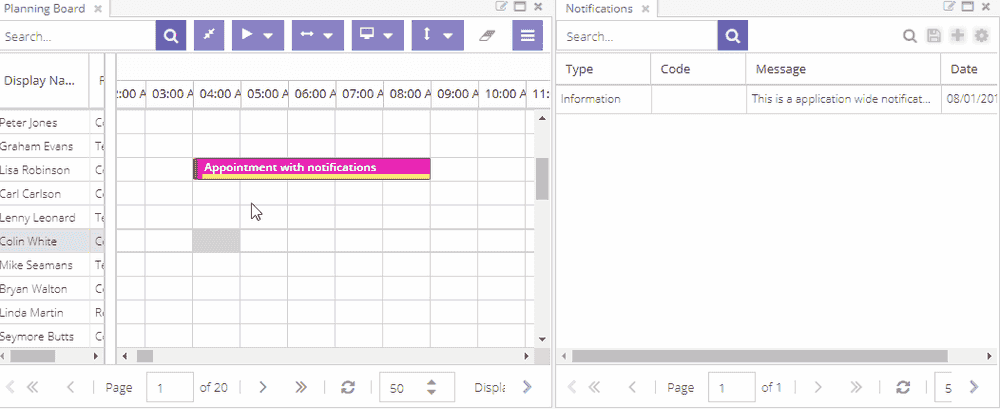
Pick a task or appointment in any grid, on the planning boardPlanning boardThe main graphical scheduling surface where dispatchers drag tasks onto resources across a timeline., or in the GanttGantt chartA timeline view for long-term project planning, showing tasks, durations, dependencies and milestones., and the grid narrows to the notifications attached to that one record. Switch selection and the grid follows. The pattern matches the details component: the planner moves their attention, the contextual components update with it.
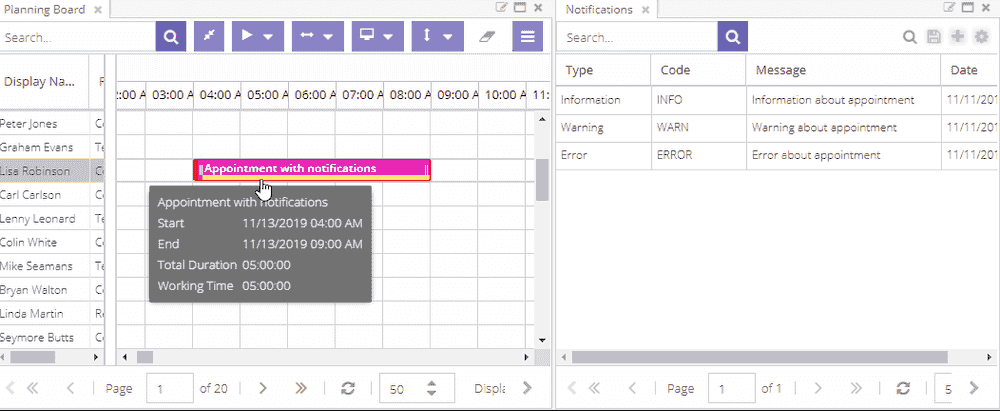
Severity at a glance
Every notification carries one of three severities: Information, Warning, or Error. The grid itself shows them with their full text, but the planning board renders a more compact signal: a small colored bar on the left of the appointment that turns the severity into a visual scan.
An informational note:

A warning:

An error:

When an appointment has more than one notification, the bar shows a marker for each severity present, so the planner can tell at a glance which categories of notes are stacked on it without having to open the appointment:
 at least one error
 at least one error and one warning
 at least one of each
A bar by itself isn't the whole story (the planner still needs to click through for the text), but it is enough to make sure nothing slips by unnoticed.
Task notifications
Tasks carry notifications too, with the same severity model. The difference is that they are not rendered as a colored bar in the open tasks grid the way appointments are on the planning board. They still surface in this component when a task is selected, so the planner sees them before they drop the task onto a resource.
Reference
The grid is stateful, like the other grids, so column selection and layoutLayoutA saved arrangement of the planning board - visible resources, columns, and settings - that can be reused. persist across sessions and can be shared.