Experimental features
Experimental features let you try new capabilities early and share feedback before they become part of the standard release. Under Dime.Scheduler's release policy, these features are made available to users so we can gather input and refine them.
Experimental features are turned off by default. You manage all feature flags in the corresponding section of the application setup.
Pages in this manual that describe a feature still at that stage open with a Preview banner, and their entries in the sidebar carry a Preview pill. The feature works and is supported, but it is being refined with early feedback: screens and behavior may still change between releases, and some of these features only appear once they have been switched on for your organization.
For more information about upcoming features available in the sandbox environment, see the Roadmap page.
New planning board
The planning boardPlanning boardThe main graphical scheduling surface where dispatchers drag tasks onto resources across a timeline. has been rebuilt on a new rendering engine. Switching New planning board on replaces the original board with the new one.
Most of what you know carries over: the same layoutsLayoutA saved arrangement of the planning board - visible resources, columns, and settings - that can be reused. and profilesProfileA saved snapshot of a user’s planning board configuration, including the chosen layout and view options. apply, and the interactions are the ones you already use. What the rewrite adds is a Configuration panel on the board itself, reached from the gear icon, which gathers the board's switches in one place:
| Setting | What it does |
|---|---|
| Snap to previous appointment | A dragged appointment settles against the end of the one before it, rather than wherever the pointer happened to be. For back-to-back work, where the gap you want is exactly none. |
| Block double bookings | Refuses a drop that would put a resource in two places at once. |
| Ignore calendars | Lets you plan outside a resource's working hours. |
| Highlight conflicts | Marks the appointments that clash. |
| Show capacity charts | Draws a capacity chart on each resource's row. |
| Show travel time | Shows the travel time in front of each appointment. |
| Show duration label | Labels each appointment with its duration. |
| Row height | Sets how many rows deep a resource's lane is drawn. |
These belong to the board's state, so a layoutLayoutA saved arrangement of the planning board - visible resources, columns, and settings - that can be reused. remembers them. You can keep one board configured strictly, with double bookings blocked and calendars respected, and another loose for rough planning.
Crew planning board
Switching New planning board crews on adds a second board whose lanes are crews rather than individual resources. Crews appear as expandable lanes with their members nested underneath, so you can plan the team and still see what that means for each person.
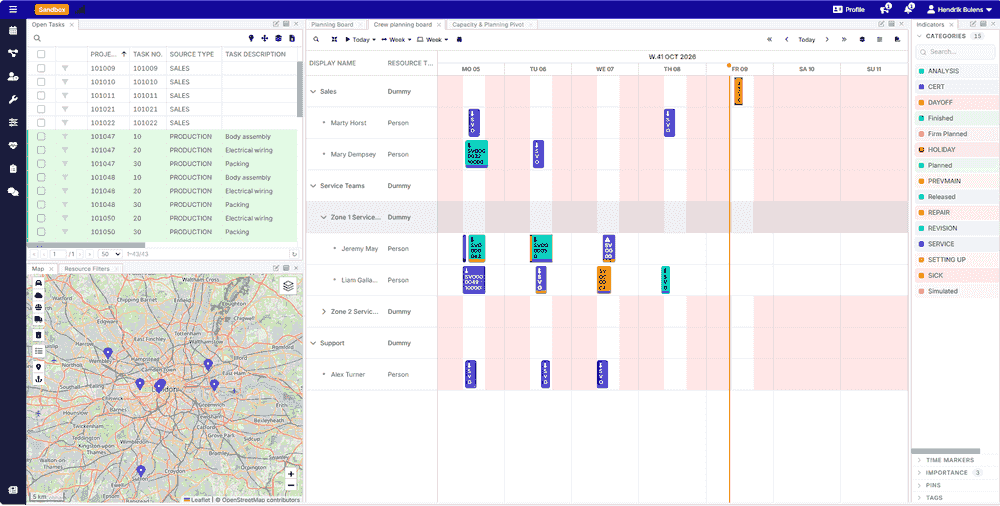 The crew planning board
This board is for the case where work is assigned to a group: drop a job on the crew lane and the booking fans out to its members. Without crews configured, the board has nothing to show.
The crew planning board
This board is for the case where work is assigned to a group: drop a job on the crew lane and the booking fans out to its members. Without crews configured, the board has nothing to show.
My Work and work states
Two switches in the Projects section of the Feature preview tab open up the project surfaces for the people who do the work. My Work adds the My Work page and its sidebar entry: one person's own schedule, tasks, projects and time. Work states adds the settings page where you define the work statesWork stateA lane on the task or project Kanban board, defined by an administrator. Statuses arriving from the back office are mapped onto work states so the board speaks your organization’s vocabulary. that become the columns of the Kanban board, and map the statuses arriving from the back office onto them. Switch on work states first if you want the Kanban board on My Work to have columns to show.
Travel time
Route and travel time calculation have been part of the application from the start. This feature lets you fold travel time directly into the schedule on the planning boardPlanning boardThe main graphical scheduling surface where dispatchers drag tasks onto resources across a timeline..
-
Select the trip by holding CTRL and clicking the appointmentsAppointmentA task scheduled to a resource for a specific period - the scheduled instance you see on the planning board. on the planning board.
-
Open the context menu and expand the 'Add travel time to selection' menu item:

-
Choose one of two modes:
- Standard: the algorithm first resets the idle time between appointments, then adds travel time between them.
- Retain lag: the algorithm keeps the schedule as is, including any idle or unplanned time between appointments, and adds travel time between them.
Zoom in and out in planning board
When switched on, you can zoom in and out on the planning board by hitting the CTRL key and zooming in and out with your mouse. This will change the view and date range according to the zoom level.
Alternating row colors
When switched on, all the grid-based components in the planning view will show alternating row colors.
Render category in background
When switched on, all grid-based components displaying appointment or taskTaskA unit of work that belongs to a job. It appears in the open task list until it is scheduled to a resource. data will render the categoryCategoryA visual indicator (a color) applied to appointments to classify or label them. color in the background of the rows.