Roles & User Actions
Roles answer the question "what is this user allowed to do?" Without them, every account would either see nothing or see everything - neither of which is what a real organisation wants. A planner needs to plan but probably shouldn't be deleting users; a viewer needs to look but not change; an administrator needs to set things up but probably doesn't want to be on the hook for everyday planning. Roles are how Dime.Scheduler lets you carve up that authority.
A roleUser roleA named bundle of user actions assigned to users and user groups. Permissions flow through roles, never directly to a user. is a bundle of permissions. A user can be assigned multiple roles, and their effective permission is the union - so you compose access rather than create a separate role for every combination.
The standard roles
Dime.Scheduler ships with a set of standard roles that cover the common scenarios. Most tenants only ever use these.
- Administrator. Full access to the Administration module.
- User Manager. Access to the Administration module, but restricted to the user setup pages - cannot touch application settings, indicatorsIndicatorCollective term for the visual signals - categories, time markers, pins, and tags - that identify and label appointments., calendarsCalendarA definition of when work can happen, for the whole tenant or for specific resources: business hours, weekends and holidays. Calendars shade non-working time on the planning board and skip it in Gantt durations., and so on.
- Application Manager. Access to the (Application) Settings module.
- Personalization. Can create and manage layouts, filters, and profiles, and share them with other users and groups.
- Planner. Full access to the planning viewPlanning viewThe main screen of Dime.Scheduler, where a profile lays out the components a planner works with. A new tenant has none until a profile is created or applied from a template.: can create, modify, and delete appointmentsAppointmentA task scheduled to a resource for a specific period - the scheduled instance you see on the planning board..
- Viewer. Read-only access to the planning view. Cannot change anything.
Editing roles and assigning user actions
Go to User Management → Roles. The page shows the list of roles on the left and the user actions that belong to the selected role on the right.
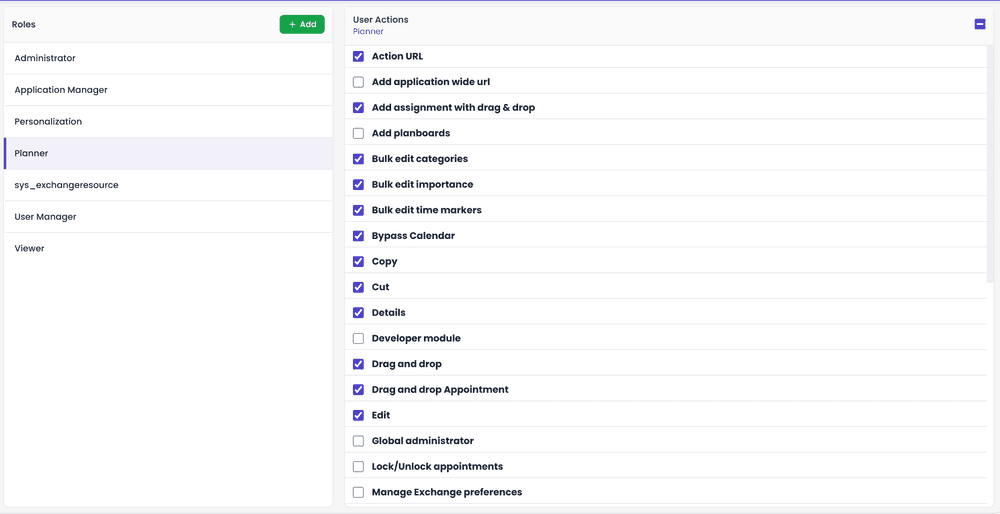
Selecting a role shows that role's permissions. Tick a user action to grant it, untick it to remove it.
The actions are grouped into collapsible categories that mirror the areas of the product they protect: Appointments, Planning board, Personalization, Open tasks, Maps, Projects, My work, Optimization, Exchange, Modules and Administration. Each category shows how many of its actions the role holds, and each has its own select-all and clear-all, so you can hand a role everything under Appointments without scrolling through the rest.
Changes take effect on the next sign-in. Ask the affected users to log out and back in; on sign-in, Dime.Scheduler applies the updated permissions and stores them in the browser cookie. There is nothing else to do.
You compose roles, but you do not define the actions they are made of. The set of user actions is part of the product: Dime Software adds one when a new feature needs protecting. You cannot add, rename or remove them, and nothing in this list is safe to change directly in the database.
Reference: every user action and what it protects
A user actionUser actionA single protected capability, such as 'edit appointment', that a role can grant. The building block of role-based access control. protects a specific feature: a button, a screen, a capability. When you assign user actions to a role, you are deciding which features that role unlocks. The groupings below are the ones the roles page uses.
Appointments
| User action | What it unlocks |
|---|---|
| New | Create manual appointments |
| Edit | Update appointments |
| Remove | Delete appointments |
| Copy | Copy appointments on the planning board |
| Cut | Cut appointments on the planning board |
| Paste | Paste appointments on the planning board |
| Details | View the details of a task, job or appointment |
| Action URL | Execute appointment action URIs on the planning board |
| Drag and drop Appointment | Move appointments by dragging them on the planning board |
| Add assignment with drag & drop | Add a second resource to an appointment by dragging |
| Bulk edit categories | Change the category of many appointments at once |
| Bulk edit time markers | Change the time marker of many appointments at once |
| Bulk edit importance | Change the importance of many appointments at once |
| Bulk edit tags | Change the tags of many appointments at once |
| Split appointments | Split an appointment into parts |
| Lock/Unlock appointments | Lock an appointment against further change, and unlock it again |
Planning board
| User action | What it unlocks |
|---|---|
| Today | Jump the board to today |
| Next | Shift the board to the next period |
| Previous | Shift the board to the previous period |
| Bypass Calendar | Plan outside a resource's working hours, skipping calendar recalculation |
Personalization
| User action | What it unlocks |
|---|---|
| Save | Save layoutsLayoutA saved arrangement of the planning board - visible resources, columns, and settings - that can be reused. |
| Add planboards | Add planning boards to a profileProfileA saved snapshot of a user’s planning board configuration, including the chosen layout and view options. |
| Save user defined filters | Save resource filters |
| Manage profile | Create and manage profiles |
Open tasks
| User action | What it unlocks |
|---|---|
| Open Task Action URL | Execute task action URIs in the open tasks grid |
| Drag and drop | Drag open tasks onto the planning board |
Maps
| User action | What it unlocks |
|---|---|
| Map Action URL | Execute action URIs from the map |
Projects
| User action | What it unlocks |
|---|---|
| Plan project | Plan a project in the Gantt chart |
| Manage projects | Create and change projects and their tasks |
| Record budget entry | Record budget entries against a project task |
My work
| User action | What it unlocks |
|---|---|
| Progress own tasks | Update the progress of tasks assigned to you |
| Log own time | Register your own time |
| View timesheets | See the tenant-wide timesheet overview, across all resources |
| Log time on behalf | Register and release time for somebody else |
Optimization
| User action | What it unlocks |
|---|---|
| Optimization | Invoke the advanced scheduling algorithms (VRP solver) from the planning board |
Exchange
| User action | What it unlocks |
|---|---|
| Manage Exchange preferences | Set your own Exchange sync preferences on the Preferences page |
Modules
These control which parts of the application a user can reach at all. Without the module, the pages beneath it are not in the menu.
| User action | What it unlocks |
|---|---|
| Scheduler module | The planning page |
| User administrator | The user setup pages, without the rest of administration |
| Settings module | The settings pages |
| Developer module | The developer pages |
| Projects | The Projects module |
| Add application wide url | Add an application-wide URL |
Administration
| User action | What it unlocks |
|---|---|
| Global administrator | Everything. Grant it sparingly |