User Generated Content
When a user leaves the company, you might think you just delete their account and move on. The problem: that user may have been the owner of a layoutLayoutA saved arrangement of the planning board - visible resources, columns, and settings - that can be reused. the whole sales team uses, a profileProfileA saved snapshot of a user’s planning board configuration, including the chosen layout and view options. the dispatchers depend on, or a filter the night shift opens every morning. Delete the account without thinking, and the shared content goes with it, silently breaking views for people who never touched the departing user's stuff.
User-generated contentUser-generated contentProfiles, layouts and filters that a user created and shared. The user-generated content page lets an administrator transfer their ownership before the user is removed. is what Dime.Scheduler calls those owned-but-shared artifacts: profiles, layouts, and filters that a user created and shared. This page is how you find them and transfer ownership somewhere safe before you remove the original owner.
Spotting the problem before deletion
The users grid in user administration shows a warning icon next to any user who owns shared content. If that icon is there, you have homework before the delete button is safe to press.
Hover the icon to see which kinds of content are involved, then click it to open the Shared Content dialog. It has a tab per content type (Filters, Layouts, Profiles), each listing the shared items with a Transfer to dropdown beside it. Pick a new owner for every item, click Reassign Ownership, and work through the tabs one at a time.
Once the warning icon is gone, the user is safe to remove.
The standalone view
The user-generated content page is the bird's-eye version of the same workflow. Use it when you want to audit ownership across the tenant, before a reorganization or when a department changes hands, rather than handling one departure at a time.
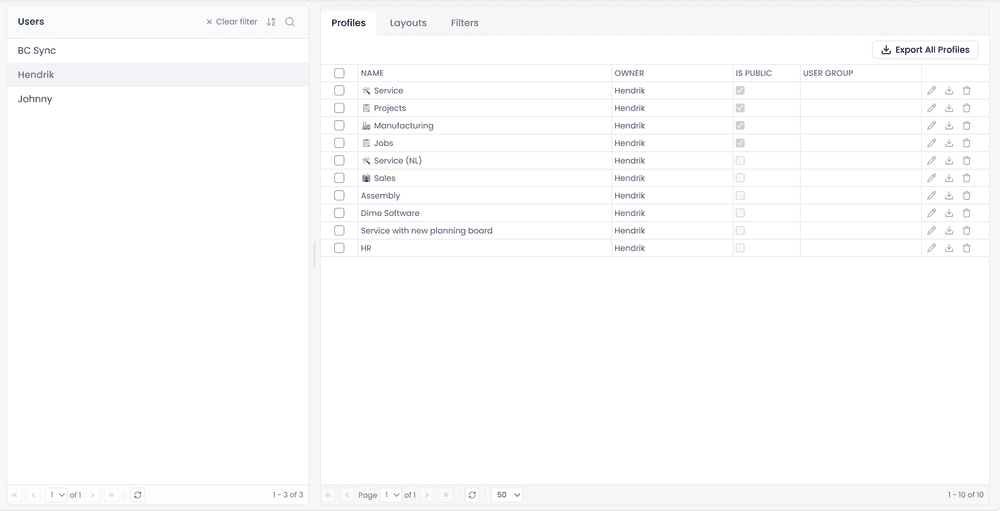
On the left is a paged list of users, with a search box and an A-Z / Z-A toggle to find the right one. On the right are three tabs, Profiles, Layouts and Filters. Select a user and the active tab narrows down to that user's content; click the same user again, or the Clear filter link that appears next to the list title, and the tabs show everything across all users. The unfiltered view is useful for spotting artifacts that should be owned by an admin but are sitting on a personal account.
Changing an artifact
The grids are read-only. To change an artifact, click the pencil icon in its row or double-click the row. A small dialog lets you rename it, pick a new Owner, toggle Is public, and attach it to a User Group; click Save to apply. What you cannot do here is edit the content of the artifact itself: that still happens in the planning viewPlanning viewThe main screen of Dime.Scheduler, where a profile lays out the components a planner works with. A new tenant has none until a profile is created or applied from a template. where the user originally built it.
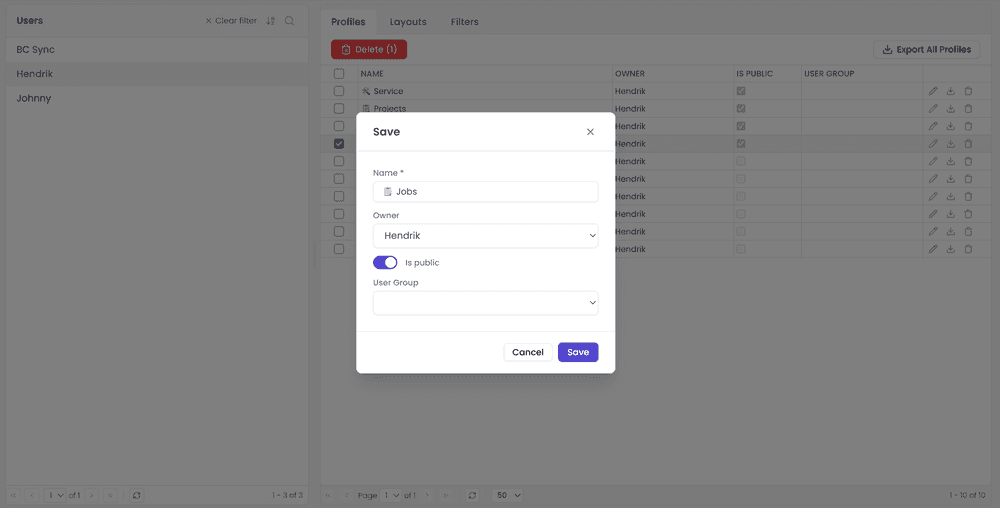
The trash icon in a row deletes that one artifact after a confirmation, and ticking several rows brings up a Delete button that removes them together. Each grid can be filtered per column, and the Layouts and Filters grids can be exported to Excel.
The Profiles tab has one more feature: a download icon per row exports that profile as a file, and Export All Profiles packages every profile in the tenant into a single archive. Use it to keep a backup of the tenant's profiles.