User Groups
User groupsUser groupA container that coalesces users so security, profiles and layouts can be managed and shared for the whole group at once. let you manage settings for collections of users in one place. You assign rolesUser roleA named bundle of user actions assigned to users and user groups. Permissions flow through roles, never directly to a user. and user profilesProfileA saved snapshot of a user’s planning board configuration, including the chosen layout and view options. to a group, and you configure data-driven securityData-driven securityRestricting which records a user can see based on the data itself - for example a region or business unit - rather than on their role. (filter valuesFilter valueA single value inside a filter group, used as a qualification on a resource or a requirement on a task., categoriesCategoryA visual indicator (a color) applied to appointments to classify or label them. and time markersTime markerA visual indicator on an appointment, separate from its category, used to flag a status or condition at a point in time.) on it, exactly as you would for an individual user.
A user inherits the settings of every group they belong to. When security is assigned on both the user group and the user, the least restrictive permissions apply. A few examples:
- The user group has only the planner role, and the user has only the "Personalization" role. The user ends up with both the planner and personalization roles.
- The user group grants values A and B for filter groupFilter groupA configurable set of fields used to filter resources and tasks on the planning board. 1, and the user is granted value D for the same filter group. The user has permissions for A, B and D, but not C.
- The user group has profile A and the user has profile B. The user can use both profiles A and B.
Groups are the answer to "I keep ticking the same ten boxes for every new planner". Set the boxes once on a group, then add each new planner to the group from the user setup.
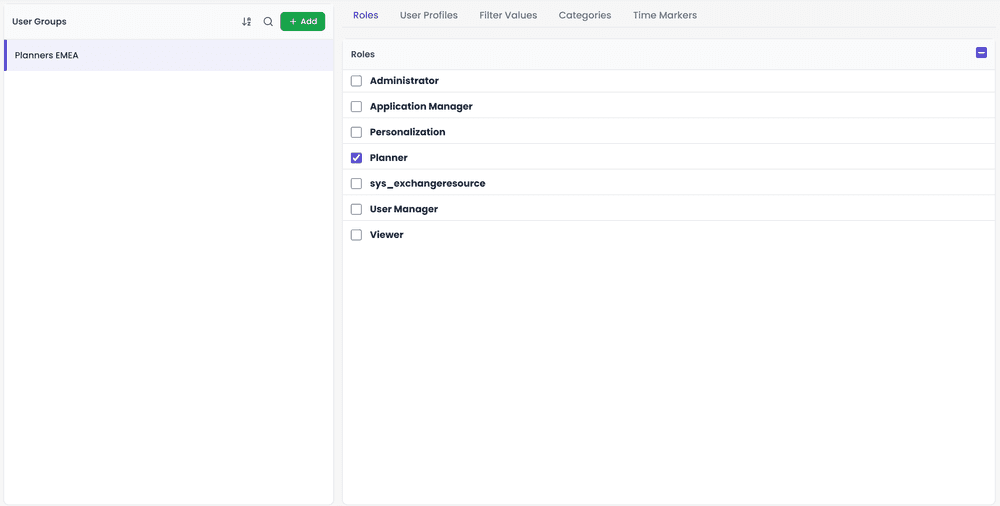
Managing the groups
The left side of the page is a plain list of groups. A group is nothing more than a name, so everything happens inline: Add opens a text box at the top of the list, the pencil icon that appears when you hover a group lets you rename it, and the trash icon asks for confirmation in place before removing it. Dime.Scheduler rejects a name that already exists, regardless of capitalization, so "Planners" and "planners" cannot coexist. When the list grows, the search icon filters it by name and the sort icon flips between A-Z and Z-A.
Assigning settings to a group
Select a group and the right side of the page shows its assignments, one tab per kind: Roles, User Profiles, Filter Values, Categories and Time Markers. Each tab is a list with a checkbox per item. Tick to assign, untick to remove; every click is saved straight away. The checkbox in the header of a tab selects or deselects the whole list.
A few tabs have extras:
- On User Profiles, assigned profiles show a star. Click it to make that profile the default for members of the group.
- On Filter Values, values are grouped by their filter group, and each group header has its own checkbox so you can grant a whole filter group at once.
Nothing is shown until a group is selected, and the same reminder from the user setup applies here: members only pick up changed assignments after they sign out and back in.