Customizing columns
This guide walks you through customizing two columns so you can tailor the look and feel of the grids. You will change the display text and formatting of a free date fieldFree fieldOne of the unmapped fields on jobs, tasks and appointments that a back office can fill with its own data, each with a localizable caption. and a free decimal field.
Prerequisites
You need to be an administrator to access the setup views. Specifically, you need the "Settings module" user actionUser actionA single protected capability, such as 'edit appointment', that a role can grant. The building block of role-based access control. assigned to your account.
Create a profile and layout
This step is optional, but a dedicated profileProfileA saved snapshot of a user’s planning board configuration, including the chosen layout and view options. and layoutLayoutA saved arrangement of the planning board - visible resources, columns, and settings - that can be reused. make the impact of each change easy to see, so we will prepare one first.
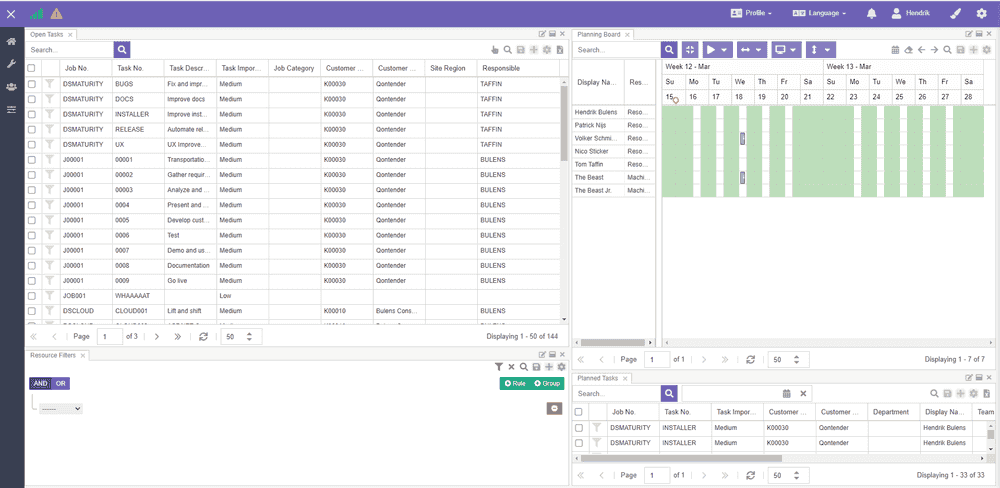
Start from the standard profile. Make the open tasksOpen taskA task that has not been scheduled yet. It waits in the open task list to be placed on the planning board. component a little wider so you can see a good number of columns, and remove any other components from the profile if needed.
Something like this works well:
Save the profile. Go to the "Profile" menu and click "Save as". In the modal window that appears, enter a descriptive name (for example "Customize Columns Guide"), mark it as the default profile, and save.
You now have access to the state buttons in the open tasks grid, which is exactly what you need. Navigate to one of the columns in the grid and open its menu. Open the columns submenu and add the columns "Task Free Date 1" and "Task Free Decimal 1". These fields accept any kind of data; they are not bound to any specific field in the back officeBack officeThe ERP or business system Dime.Scheduler plans for - most often Microsoft Dynamics 365 Business Central. It owns the master data and remains authoritative over what it receives., so it is up to you to give each column a meaning.

Once the columns are added, move them to the left. Locate them in the grid, drag the column headers to the left, and make them a little wider:

Save the layout. Click the icon in the open tasks grid. In the modal window that appears, enter a descriptive name (for example "Customize Columns Guide"), mark it as the default layout, and save.
That is all for the planning viewPlanning viewThe main screen of Dime.Scheduler, where a profile lays out the components a planner works with. A new tenant has none until a profile is created or applied from a template.. Now it is time to configure these columns.
Locate the columns
Go to Settings -> Localization to open the localizationLocalizationThe settings page that translates captions, maps localized country names to ISO codes for geocoding, and sets date and decimal formatting per language. settings view.

As the name suggests, this view handles the localization of the application. The first tab lets you provide custom captions for many fields and columns, which is what you need here.
The grid on the left displays every field that can be customized. Add a filter to the "Field name" column for fields that contain the text "Free", and add a filter to the "Source table" column for fields that contain the text "Task". Somewhere in the middle of the grid you should find the records "FreeDecimal1" and "FreeDate1".

Start with the decimal field.
Configure the decimal field
In this section you will do two things: change the column captionCaptionThe label shown for a field or entity in the interface, translatable per language. A tenant that calls jobs "projects" changes the caption, not the data model. (which is "Free Decimal 1" in English) and change how decimal values are displayed.
Decimal formatting
The supported decimal formats are documented in the localization settings. Suppose you want 4-digit precision, so the value 1.5 is displayed as 1.5000. The format to enter is "0.0000".
In the translations grid, make sure the "Free Decimal 1" field is selected. Double-click the record and enter 0.0000.

Save the changes.
Decimal caption
The grid on the right, called "Captions", is contextual: it shows the captions for whichever field is selected in the fields grid. With the "Free Decimal 1" field still selected, click the "Add" button in the "Captions" grid:

Now do two things: select the language and enter the corresponding caption. Stick to English and give it a name:

Save the changes.
Configure the date field
In this section you will do two things: change the column caption (which is "Free Date 1" in English) and change how date values are displayed. The steps are the same as the previous section.
Date formatting
The supported date formats are documented in the localization settings. Suppose you want to show the full representation of the date, so the value 2020/03/15 is displayed as "March 15 2020 10:10". The format to enter is "F j Y g:i".
In the translations grid, make sure the "Free Date 1" field is selected. Double-click the record and enter "F j Y g:i".

Save the changes.
Date caption
The grid on the right, called "Captions", is contextual: it shows the captions for whichever field is selected in the fields grid. With the "Free Date 1" field still selected, click the "Add" button in the "Captions" grid:

Now do two things: select the language and enter the corresponding caption. Stick to English and give it a name:

Save the changes.
Validate changes
Navigate back to the planning view. Notice how the column names and formatting have changed:

From now on, every reference to this field uses the caption rather than the default translation. The pane contents setup is one example:

The task details window also uses the new formatting and captions:
