My Work
Most of Dime.Scheduler is built for the planner: somebody looking at forty people and two hundred jobs. My Work is built for one of those forty. It is the signed-in person's own page: their schedule, the tasks they can move along, the projects they are on, and the time they have logged. Nothing on it widens beyond that person, and that is the point. A technician does not need the board. They need to know where they are going today, what they are expected to do there, and how to write down what they did.
My Work appears in the main menu only once it has been switched on for your organization, and only for users who hold at least one of the two user actions below.
Who the page belongs to
The page shows the resourceResourceAn entity that can carry out work - a person, vehicle, tool, or room - that you schedule on the planning board. linked to your user account, and the link is made by e-mail address: a resource whose e-mail matches the one you sign in with is yours. If no resource matches, the page says so and shows nothing else. Ask your administrator to put your e-mail on your resource record.
If the same e-mail sits on more than one resource, My Work shows them together. Time is always logged on the first one.
Two user actionsUser actionA single protected capability, such as 'edit appointment', that a role can grant. The building block of role-based access control. decide what you get, and neither depends on being a planner:
| User action | What it unlocks |
|---|---|
| Progress own tasks | The Board tab, and dragging cards on it |
| Log own time | The Timesheet and Insights tabs |
The Schedule and Projects tabs need no action beyond the resource link. See roles and user actions.
Schedule
The landing tab. On the right, a read-only calendar of your own appointments in day, week, month or list view, with a settings popover for the zoom level, whether weekends show, and the hours of the day to draw. On the left, three short lists: Today, This week and Up next. They are reckoned from now rather than from whatever day the calendar is showing, so browsing to next month does not move today's list.
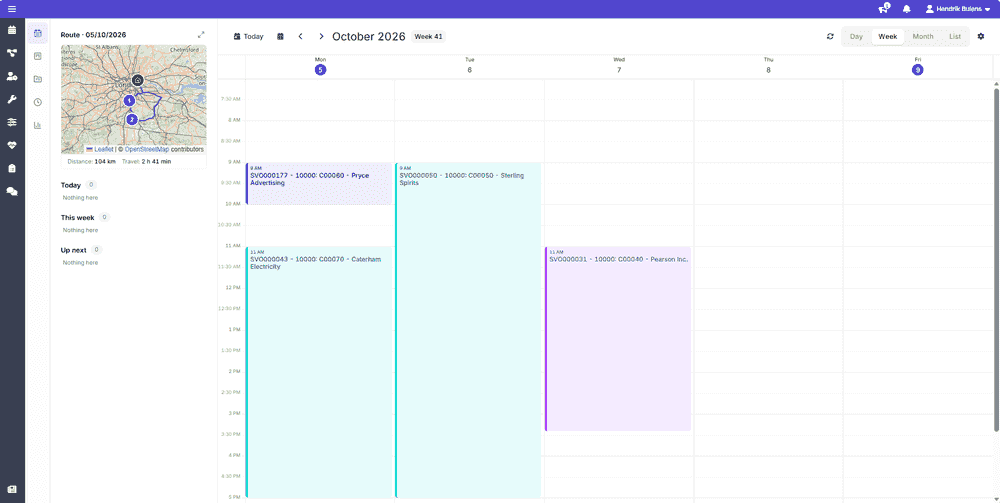 The schedule, with the day's route beside it
Above the lists sits the day's routeRouteThe path between a set of stops drawn on the map, with travel time and distance per leg. The route sequence grid lists the same stops as rows.: a small map with the stops numbered in schedule order, the distance between them and the travel timeTravel timeThe time needed to get from one appointment to the next, calculated from their locations. The planning board can show it in front of each appointment and fold it into the schedule.. It follows the day the calendar is on, so stepping to Thursday shows Thursday's route. The map needs the map license, and a stop without an address is counted rather than drawn.
The schedule, with the day's route beside it
Above the lists sits the day's routeRouteThe path between a set of stops drawn on the map, with travel time and distance per leg. The route sequence grid lists the same stops as rows.: a small map with the stops numbered in schedule order, the distance between them and the travel timeTravel timeThe time needed to get from one appointment to the next, calculated from their locations. The planning board can show it in front of each appointment and fold it into the schedule.. It follows the day the calendar is on, so stepping to Thursday shows Thursday's route. The map needs the map license, and a stop without an address is counted rather than drawn.
Board
Your tasks as cards in columns, for moving work along without opening anything.
 The board
The columns are the work statesWork stateA column on the Kanban board, defined by an administrator. Statuses arriving from the back office are mapped onto work states so the board speaks your organization’s vocabulary. your administrator defines, the same ones the project Kanban uses, with an Unmapped column at the front for tasks whose status nobody has mapped to a column yet. If no work states exist, the board has nothing to draw and says so.
The board
The columns are the work statesWork stateA column on the Kanban board, defined by an administrator. Statuses arriving from the back office are mapped onto work states so the board speaks your organization’s vocabulary. your administrator defines, the same ones the project Kanban uses, with an Unmapped column at the front for tasks whose status nobody has mapped to a column yet. If no work states exist, the board has nothing to draw and says so.
The board shows the tasks you have an appointmentAppointmentA task scheduled to a resource for a specific period - the scheduled instance you see on the planning board. for inside the date range at the top, which starts as the current week. Show unplanned adds the open tasksOpen taskA task that has not been scheduled yet. It waits in the open task list to be placed on the planning board. that have no appointment yet, so the work you have been given but not yet scheduled for is visible too. Finished unplanned work stays hidden, since it would only flood the done column. The project dropdown narrows the board to one or more projects, and the search box looks through titles, descriptions and task and job numbers.
 Dragging a card to another column
Dragging a card to a column sets the task's status to the one that column stands for. Two drops change nothing on purpose: dropping on Unmapped, and dropping on the column the card is already in, which keeps a finer sub-status intact rather than overwriting it. Clicking a card jumps to the Schedule tab on the day of its earliest appointment.
Dragging a card to another column
Dragging a card to a column sets the task's status to the one that column stands for. Two drops change nothing on purpose: dropping on Unmapped, and dropping on the column the card is already in, which keeps a finer sub-status intact rather than overwriting it. Clicking a card jumps to the Schedule tab on the day of its earliest appointment.
Projects
The projects you are a team member of, whether or not any of your work on them is scheduled yet. That is deliberately a different list from the board's: membership is a decision somebody made about you, and it should be visible before the first appointment lands.
 A project as its team member sees it
Each project lists how much of your work on it is open and overdue, and when you are next due on it. Opening one shows My open work across all time rather than only the current window, the site and contact details of the job so you can call ahead, and how much time you have logged on it in the last thirty days. Users with access to the projects module get an Open project link to the full project page.
A project as its team member sees it
Each project lists how much of your work on it is open and overdue, and when you are next due on it. Opening one shows My open work across all time rather than only the current window, the site and contact details of the job so you can call ahead, and how much time you have logged on it in the last thirty days. Users with access to the projects module get an Open project link to the full project page.
Timesheet
Where your time is recorded. The tab has two surfaces, and it always opens on the first.
Tracked time is what the timer measured. Start a timer against a task, stop it when you are done, or log a stretch by hand for the time the timer never saw. Three tiles at the top add the week up: what was tracked, what is already on a timesheet, and what is not yet. The running timer is in none of them, because a clock still moving is not a measurement.
 Tracked time
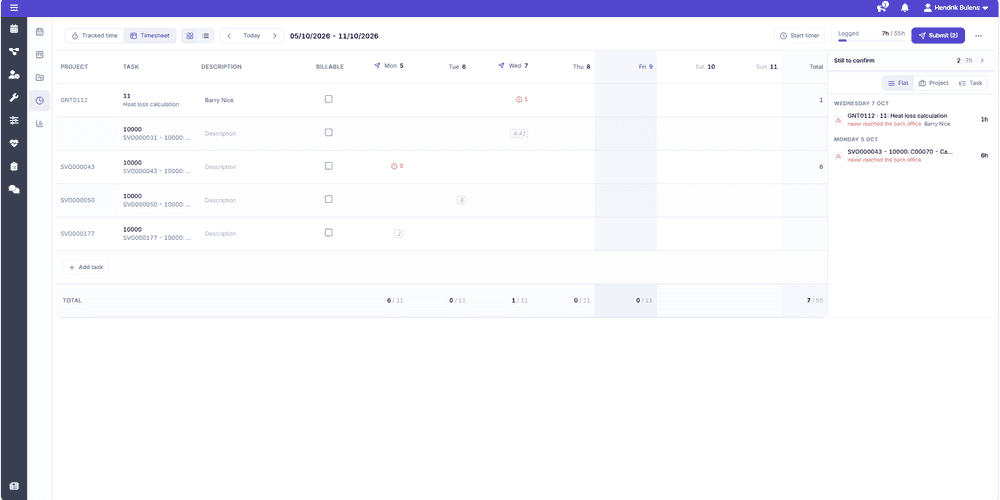
Timesheet is the week as a grid, one row per task and description, one column per day. Cells drawn as a dashed outline are suggestions: what your schedule planned for that day, or what the timer tracked and you have not yet confirmed. Confirming a tracked suggestion at its own figure keeps the measured times behind the line. Typing a different number is a plain entry that stands on its own.
Tracked time
Timesheet is the week as a grid, one row per task and description, one column per day. Cells drawn as a dashed outline are suggestions: what your schedule planned for that day, or what the timer tracked and you have not yet confirmed. Confirming a tracked suggestion at its own figure keeps the measured times behind the line. Typing a different number is a plain entry that stands on its own.
 The timesheet grid with the Still to confirm panel
The Still to confirm panel beside the grid is the queue of what still needs you: tracked time that never became a line, and lines that came back from the back officeBack officeThe ERP or business system Dime.Scheduler plans for - most often Microsoft Dynamics 365 Business Central. It owns the master data and remains authoritative over what it receives. refused or that never reached it. It reads most recent day first, because what is owed is read backwards from now. A line marked never reached the back office failed on the way out and can simply be sent again. A refused one needs a person to read the reason first.
The timesheet grid with the Still to confirm panel
The Still to confirm panel beside the grid is the queue of what still needs you: tracked time that never became a line, and lines that came back from the back officeBack officeThe ERP or business system Dime.Scheduler plans for - most often Microsoft Dynamics 365 Business Central. It owns the master data and remains authoritative over what it receives. refused or that never reached it. It reads most recent day first, because what is owed is read backwards from now. A line marked never reached the back office failed on the way out and can simply be sent again. A refused one needs a person to read the reason first.
Submit releases the week's lines to the back office. From then on they are locked, and whether they are approved is decided there, not here. For what the statuses mean once a line has left, see timesheets. For the thinking behind sessionsTime sessionAn observation that a resource was working, travelling or waiting on a task between two moments. Sessions support a time entry and never reach the back office on their own. and claims, which is the same on the mobile app, see time tracking.
Insights
How your logged time compares with what was planned and what you were available for, by week or by month.
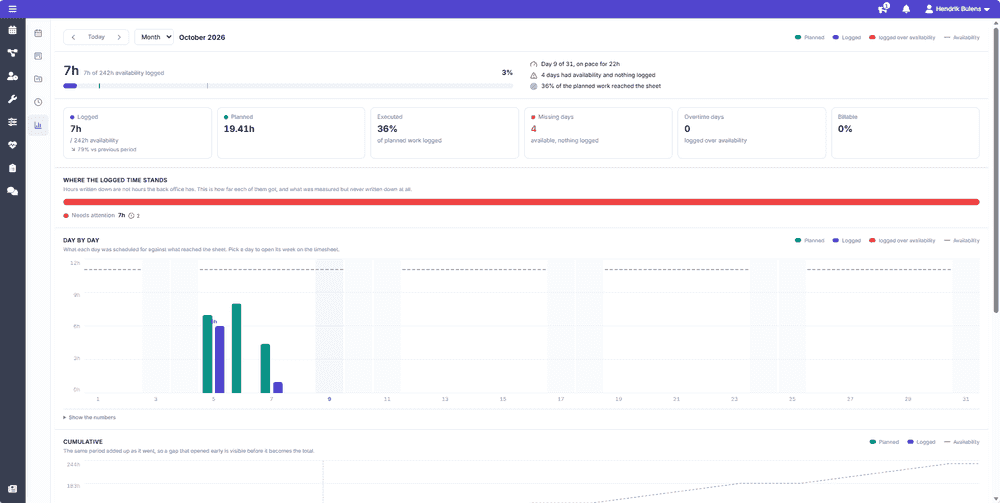 Insights for a month
The tiles are the summary: hours logged against your availability, hours planned, how much of the planned work was logged, the days you were available but logged nothing, the days you logged more than you were available for, and the billable share. Each carries a comparison with the previous period, deliberately without a color, since more hours than last month is not automatically good news.
Insights for a month
The tiles are the summary: hours logged against your availability, hours planned, how much of the planned work was logged, the days you were available but logged nothing, the days you logged more than you were available for, and the billable share. Each carries a comparison with the previous period, deliberately without a color, since more hours than last month is not automatically good news.
Where the logged time stands splits the logged hours by how far they got: approved in the back office, held there awaiting approval, still submitting, still draft, or needing attention because they failed or were refused. Tracked time that never made it onto a timesheet is counted underneath rather than in the bar, because a bar that included it would state a total the back office will never see.
Day by day and Cumulative draw planned against logged over the period, the second as a running total so a gap that opened early is visible before it becomes the final figure. Picking a day opens its week on the Timesheet tab.
Availability comes from your resource's capacity. If your organization does not maintain capacities, the availability figures disappear and the comparisons fall back to planned hours.
Related
- Timesheets - the oversight page where a team lead reviews everybody's time.
- Time - sessions, claims and why they are kept apart.
- Mobile app - the same timer and claims, on the phone.
- Project planning - the projects whose team you are on.